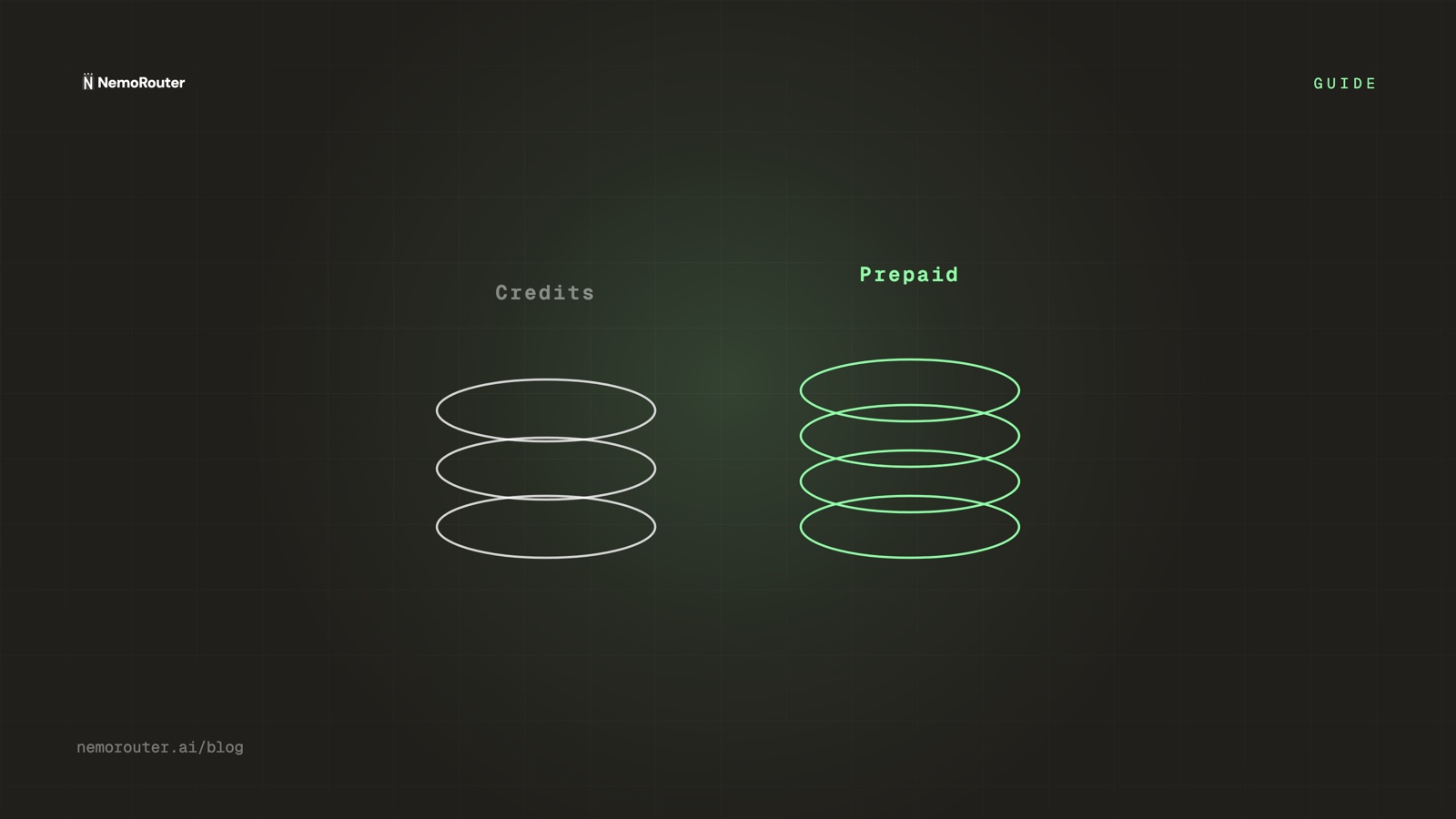
"Credits" and "prepaid tokens" sound interchangeable, and teams often assume a gateway's credits work like the prepaid balance they know from a single provider. They don't, and the difference matters once you're calling more than one model. This guide explains what gateway credits actually are, how they differ from provider-prepaid tokens, and why a dollar-denominated balance fits a multi-model world.
Prepaid tokens: provider-scoped, model-coupled
When you prepay a provider, you're typically buying spend against that provider's models at that provider's prices. Your balance is implicitly coupled to a pricing sheet:
- It only works with that provider's models.
- Its value shifts if that provider changes pricing.
- You hold a separate balance per provider, each reconciled separately.
- Switching models means switching balances.
It works fine in a single-provider world. In a multi-model world it fragments: N providers, N prepaid balances, N pricing sheets to track.
Gateway credits: model-agnostic dollars
Gateway credits are denominated in dollars of spendable value, not tokens of a specific model. One balance funds calls to any model behind the gateway:
PREPAID TOKENS                  GATEWAY CREDITS
balance = tokens @ Model X      balance = $ of value
  ├─ only Model X                 ├─ any model, any provider
  ├─ N balances for N providers   ├─ ONE balance
  └─ value tied to X's pricing    └─ each call costs its real price
A call's cost is the provider's authoritative price at the moment it runs, debited from your one dollar-balance. Call a cheap model, a little is debited; call a flagship, more is. Switch models freely — same balance, no migration.
Credits are dollars, so the math stays honest
Because credits are dollar-value and each call settles at the provider's real cost, your balance is always "how many dollars of inference do I have left," not "how many tokens of a model I might not even use." That's what lets one balance fund a RAG app that mixes embeddings and chat, or an agent that routes across models mid-task.
You keep 100% of what you buy
A key property of NemoRouter credits: 100% of your purchase becomes spendable credits. The platform fee is charged on top at purchase time, not skimmed from the credit amount or baked into a per-token markup. So $100 bought is $100 of inference value — every call debits the provider's real cost with no hidden cut. (The full model: markup-free credits.)
This is the opposite of a per-token markup, where your "tokens" quietly cost more than the provider charges because the gateway's cut is folded in. Dollar credits with a visible fee keep the value transparent.
What this enables
Model-agnostic dollar credits aren't just tidier — they unlock things prepaid tokens can't:
- Switch or route models freely — no balance migration when you move a task to a cheaper model.
- One budget across everything — cap dollars, not per-model token pools.
- One bill, one reconciliation — not N provider balances to true up.
- New models work immediately — a new model is just another thing your dollar-balance can fund.
The takeaway
Prepaid tokens are a single provider's currency — model-coupled, provider-scoped, fragmented across vendors. Gateway credits are dollars of spendable value that fund any model behind one endpoint, settle at each call's real cost, and (here) give you 100% of your purchase with the fee on top. In a world where you call more than one model, a dollar-denominated balance is simply the right unit. See it on the pricing page.