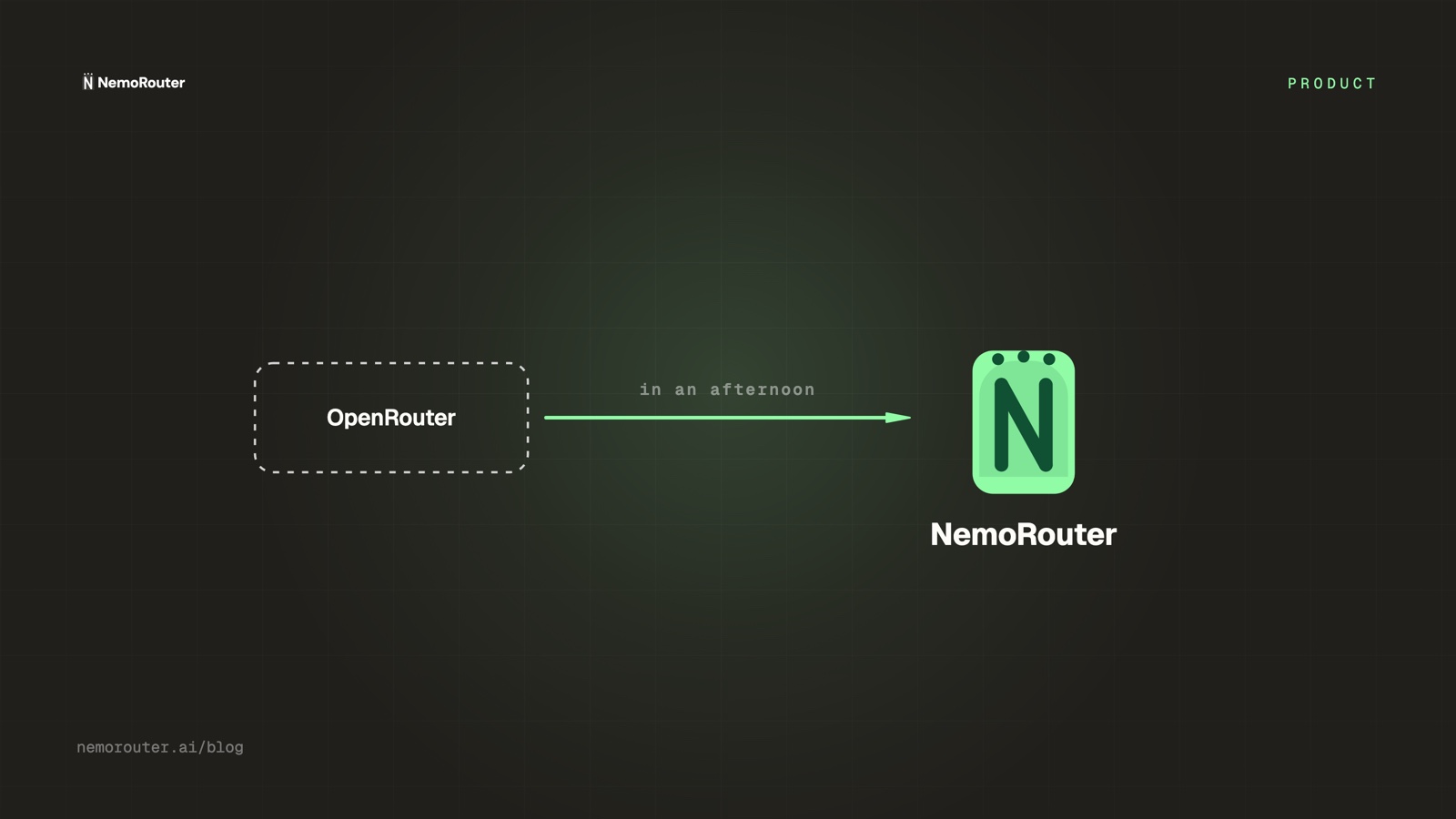
The reason gateway migrations feel scary is the assumption that you'll rewrite your integration. You won't. If your app speaks the OpenAI-compatible API — and through OpenRouter it does — moving to NemoRouter is a base-URL and key change, plus a verification pass. The interesting part isn't the migration mechanics (they're trivial); it's what changes underneath once you're there.
Why the switch is nearly free
Both OpenRouter and NemoRouter expose an OpenAI-compatible surface. Your code already calls chat.completions.create() against a base URL with a bearer key. Migration is repointing those two values:
  client = OpenAI(
-     base_url="https://openrouter.ai/api/v1",
-     api_key=OPENROUTER_KEY,
+     base_url="https://api.nemorouter.ai/v1",
+     api_key=NEMOROUTER_KEY,   # sk-nemo-...
  )
  # the rest of your code is unchanged
No SDK swap, no request-shape rewrite, no new client library. The calls, the message format, the streaming — all the same. (This is the same OpenAI-compatible contract documented for any LLM gateway.)
The afternoon, step by step
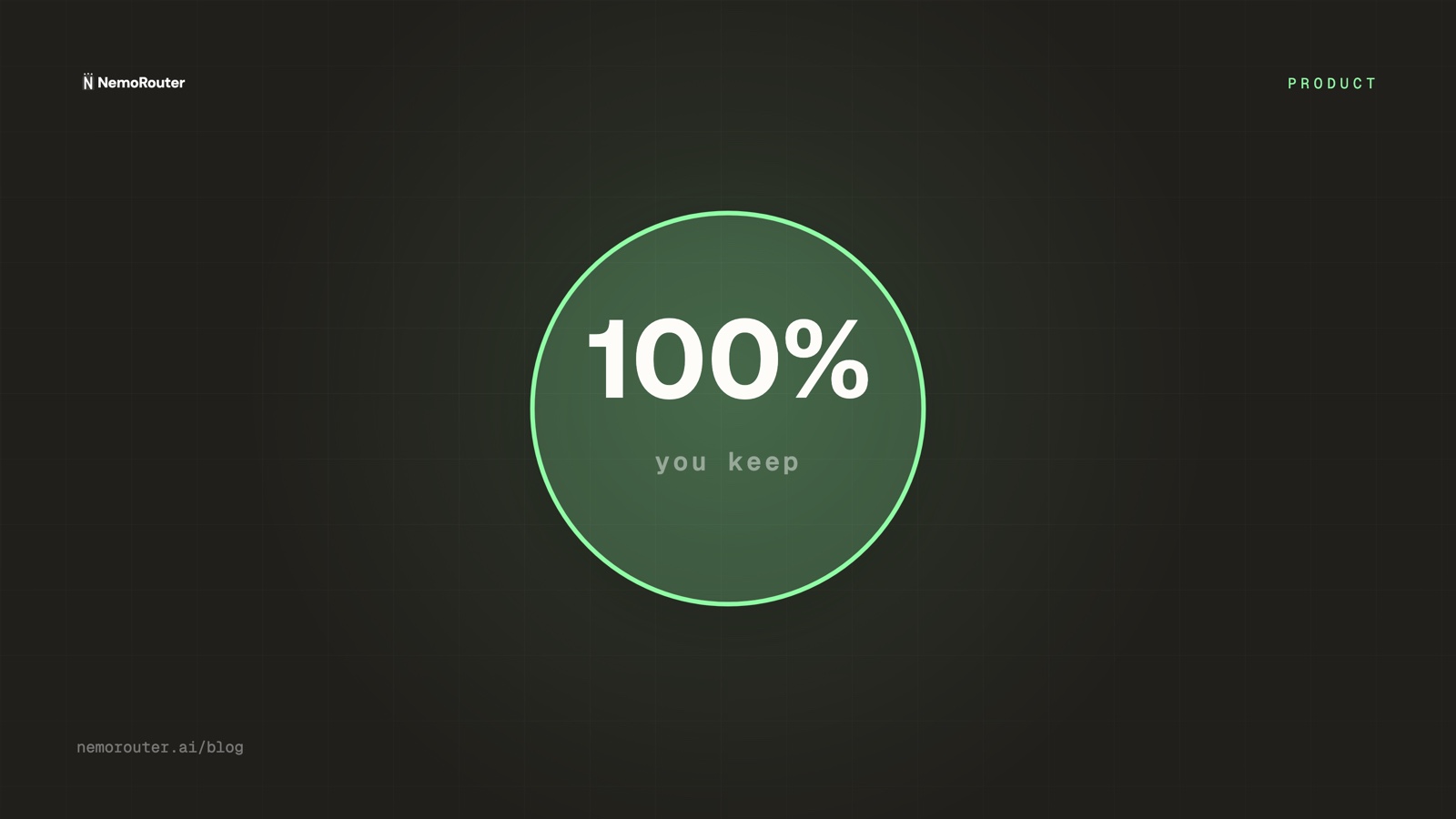
- Create a NemoRouter account + virtual key. Buy credits (you get 100% of them; the platform fee is on top at purchase, not skimmed per call).
- Repoint base URL + key in one config place (an env var, ideally). If your keys are centralized, this is one line.
- Map model names. Confirm the model slugs you use resolve; adjust any that differ. Check the models page for the live catalog.
- Verify in staging. Run your existing test traffic; confirm responses, streaming, and that cost headers come back.
- Cut over. Flip the env var in prod. Keep the old key for a day as a rollback.
That's it. Most teams spend more time scheduling the change than making it.
Check model-name mapping before cutover
The one thing that bites: a model slug your code hardcodes may be named differently here. Pull the live model list and map any mismatches before prod cutover, not after. The base-URL change is instant; a wrong model name is a 404 you want to catch in staging.
What you gain on the other side
The migration is easy; the reason to do it is what you get:
| Typical aggregator | NemoRouter | |
|---|---|---|
| Pricing | Often a per-call markup | 100% of credits; fee on top at purchase |
| Governance | Limited | Budgets, RBAC, guardrails — free on every tier |
| Cost tracking | Varies | Exact, from the provider's real cost |
| Spend caps | Basic | Caps that hold under concurrency |
| Multi-tenancy | Minimal | Org → team → key scoping |
You keep the OpenAI-compatible simplicity and gain the governance layer most teams eventually need — without self-hosting and without a markup on every token. (For the full comparison, see the OpenRouter alternative write-up.)
Rollback is just as easy
Because the migration is a config flip, so is the rollback: point the env var back. Keep your OpenRouter key live for the first day, watch your error rate and cost headers, and you've got a zero-drama escape hatch. A migration you can reverse in one line is a migration you can do on a Tuesday afternoon.
The takeaway
Don't let "switching gateways" sound bigger than it is. It's a base-URL and key change against the same OpenAI-compatible API, a model-name check, and a staging pass — reversible in one line. Do it in an afternoon and you trade a per-call markup for governance that's free on every tier. Start with a key and some credits, point staging at it, and see.