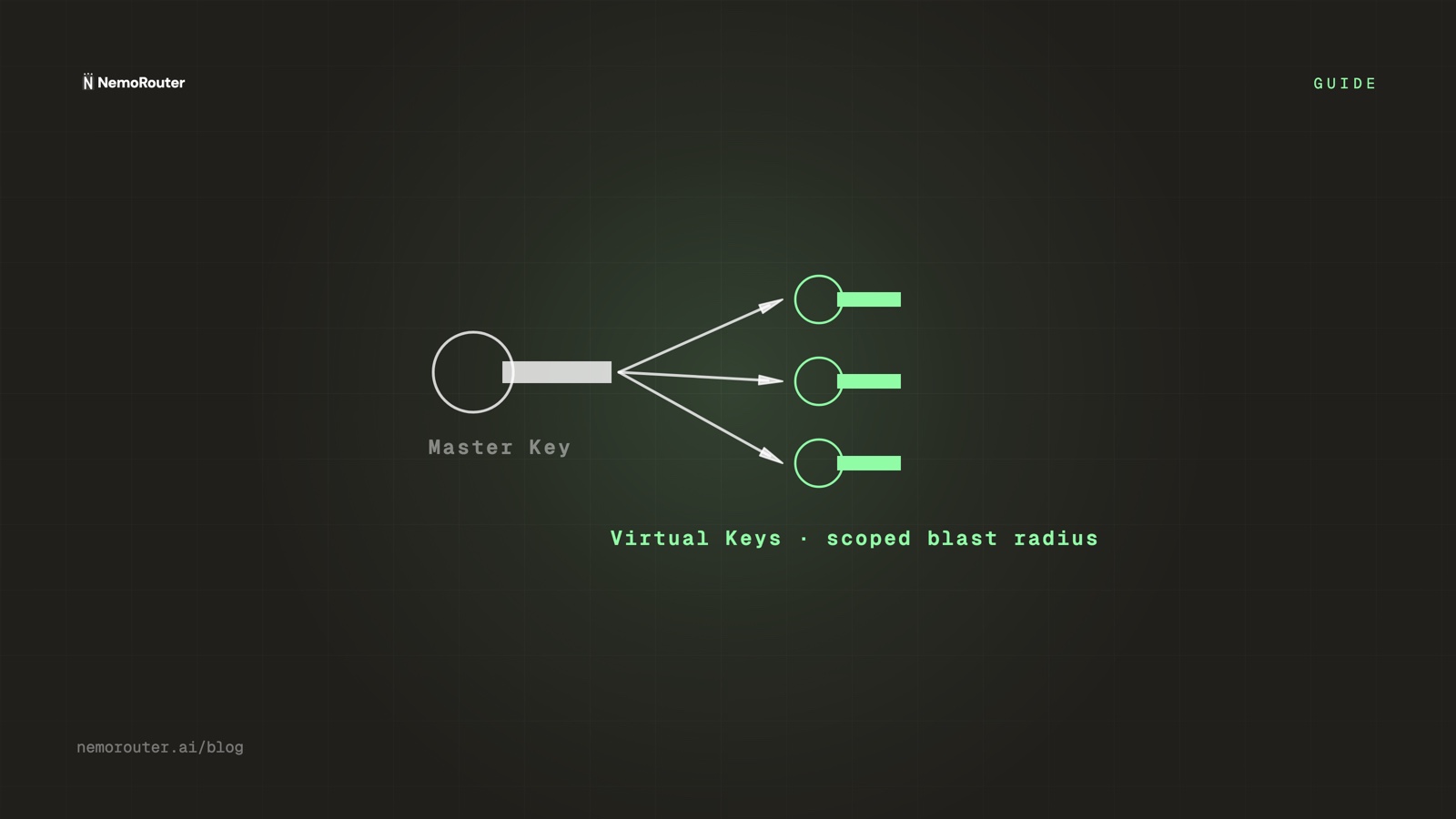
Every API key is a liability the moment it leaves your control. The question isn't "will a key leak" — over a long enough horizon, one will — it's "how much can the leaked key do?" Good key design answers that with the smallest possible number. NemoRouter splits keys into two kinds with very different powers: a single master key that manages, and many virtual keys that use. The split is the whole point.
Two kinds of key, two jobs
| Master key | Virtual key (sk-nemo-*) | |
|---|---|---|
| Count | One | Many (per app, job, env) |
| Power | Management CRUD (create keys, orgs) | Make LLM calls only |
| Used by | Account management only | Apps, SDKs, the playground |
| Rate-limited / budgeted | n/a | Yes — per key |
| Spend-tracked | n/a | Yes — per key |
| If leaked | Catastrophic — rotate everything | Bounded — revoke the one key |
The master key is the root of management authority; it can create and delete keys and orgs. The virtual key can do exactly one thing: make inference calls, under the limits and budget you set for it. That asymmetry is deliberate — the powerful key stays put, and the traveling keys aren't powerful.
The rule: customer traffic never uses the master key
This is non-negotiable on NemoRouter. Every LLM inference request — from an SDK, the API, the playground — authenticates with a virtual key, never the master key. Management operations (creating a key, an org) are the only place the master key is used, and it is kept out of anything a client can see.
A master key in client code is a full compromise
If the master key ever reached a browser bundle, a mobile app, or a notebook, a leak wouldn't be "someone ran up a bill" — it'd be "someone can create and delete keys and orgs." That's why you keep it out of client code, and customer traffic is virtual-key-only. The blast radius of a frontend compromise is bounded to virtual keys, which are rate-limited, budgeted, and revocable.
Why virtual keys make a leak survivable
Because each virtual key is independently scoped, a leaked one is a contained incident, not a crisis:
- Revoke just it. Delete the leaked key; every other key keeps working. No mass rotation.
- It was already capped. A virtual key carries its own budget and rate limits, so even before you notice the leak, the damage is bounded by the cap you set.
- You can see what it did. Per-key spend tracking means the leaked key's activity is fully attributed — you know exactly what happened.
The design turns "a key leaked" from a fire drill into a routine revoke-and-replace, because you scoped the blast radius in advance.
Display keys safely
A key you can read off a screen is a key that can be shoulder-surfed, screenshotted, or logged. So the full secret is shown exactly once — at creation — and never again. After that, the dashboard shows only a safe label: the name plus the last four characters (sk-...a1b2). There's no "reveal" button, because there's nothing to reveal — we don't store the full key in a form anyone can retrieve. Lose it, rotate it; you never get the old one back, and neither does an attacker.
Scope keys to jobs
The practical advice that falls out of this: create a virtual key per use, not per user. One key for the nightly batch, one for the chat feature, one for staging. Then:
- a leak is scoped to one job's blast radius,
- spend is attributed per job for free,
- revoking one job's key doesn't touch the others.
A single shared key for everything re-couples what virtual keys exist to separate — you lose the per-job attribution and a leak takes down all of it at once.
The takeaway
Key security is blast-radius design. Keep one powerful master key for management and never let it travel; issue many narrow virtual keys for actual traffic, each capped, tracked, and revocable; show the full secret once and only the last four after. Then the inevitable leak is a contained, recoverable event — not the end of the world. Manage keys in the dashboard; they're free on every tier.