

Introduction
Get started with Nemo Router — your enterprise LLM gateway
Last updated
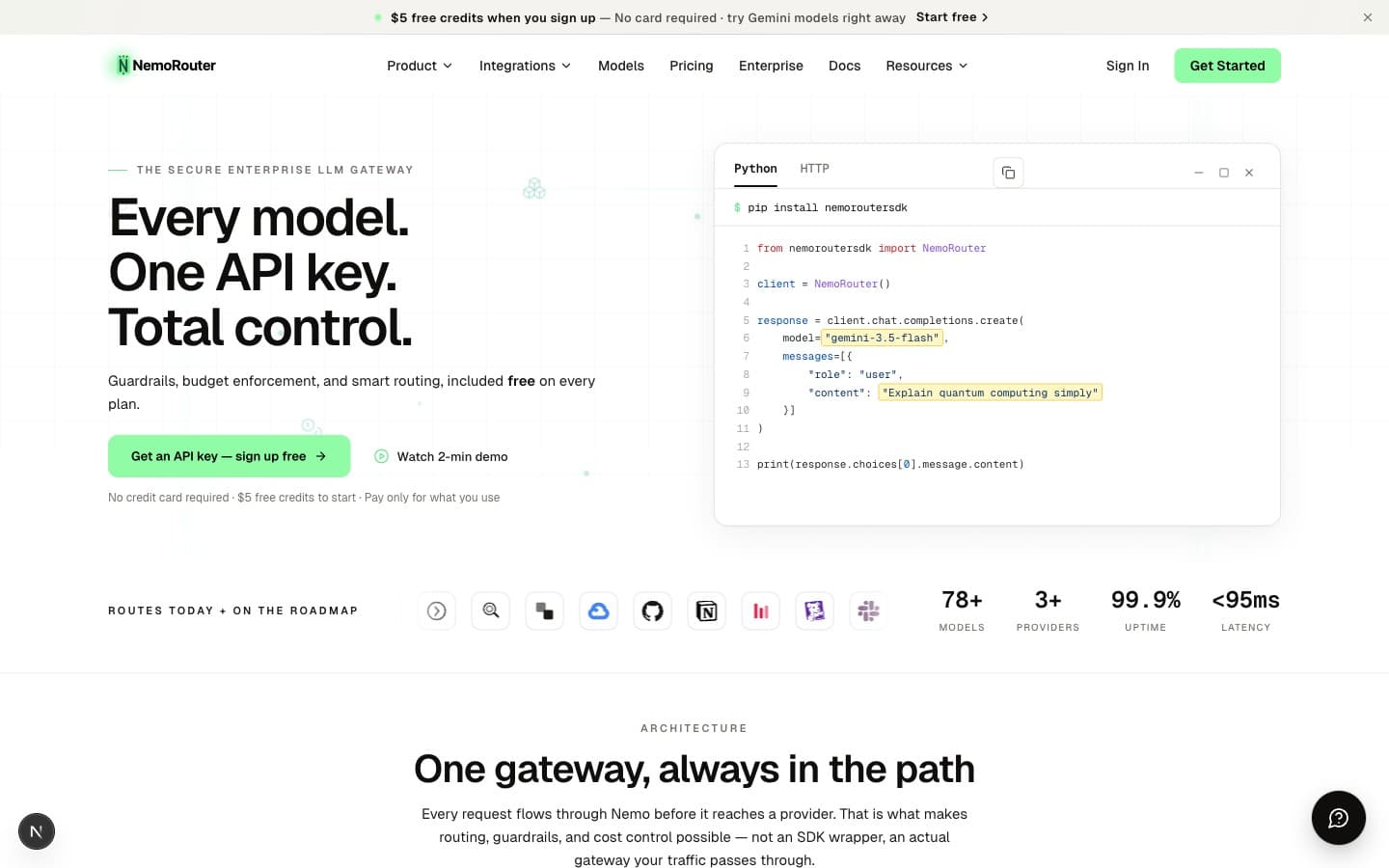
Nemo Router is an enterprise LLM gateway that gives your team one API key, one bill, and zero provider configuration. Call any LLM through a single OpenAI-compatible endpoint. 78+ models from Anthropic, Google, and OpenAI are live today, with AWS Bedrock shipping next and Azure OpenAI, Meta, and Mistral on the roadmap.
Why Nemo Router?
Managing multiple LLM providers is painful. Different API keys, different billing dashboards, different SDKs, different rate limits. Nemo Router eliminates all of that.
| Without Nemo Router | With Nemo Router |
|---|---|
| Manage API keys for every provider | One NEMOROUTER_API_KEY for everything |
| Separate billing per provider | Single credit balance, one invoice |
| Different SDKs and endpoints | OpenAI-compatible — use any existing SDK |
| No visibility across providers | Unified analytics, spend tracking, and logs |
| No safety controls | Built-in guardrails, budget controls, and rate limits |
Key Features

One Key, One Bill
Buy credits, call any model. Nemo Router manages all provider keys behind the scenes. You never touch a provider API key.
OpenAI-Compatible API
Use any OpenAI SDK or HTTP client. Just change the base URL to https://api.nemorouter.ai/v1 and swap your API key. Your existing code works immediately.
One Endpoint, Growing Catalog
Access 78+ models through a single endpoint — no per-provider keys or SDKs:
- Anthropic (live) — Claude Opus, Sonnet, and Haiku
- Google (live) — Gemini 2.5 Pro, Gemini 2.5 Flash, Gemini 2.5 Flash-Lite, and more
- OpenAI (live) — GPT and o-series models
- AWS Bedrock — (shipping next)
- Azure OpenAI, Meta, Mistral — (on the roadmap)
See the Models page for the current live catalog.
Enterprise Controls
- Guardrails — Content safety, PII detection, prompt injection prevention
- Budget controls — Spending limits per key, team, or organization
- Rate limits — RPM and TPM controls to prevent runaway costs
- Team management — Roles, permissions, and per-team budgets
- Analytics — Real-time spend tracking, usage breakdowns, and request logs
Getting Started
Getting up and running with Nemo Router takes three steps:
1. Create an Account
Sign up at nemorouter.ai and complete the onboarding flow. You'll set up your organization and choose a plan.
2. Get Your API Key
After onboarding, create an API key from the API Keys page in your dashboard. Your key will look like sk-nemo-xxxx. Copy it immediately — it's only shown once.
3. Make Your First Request
curl https://api.nemorouter.ai/v1/chat/completions \
  -H "Authorization: Bearer $NEMOROUTER_API_KEY" \
  -H "Content-Type: application/json" \
  -d '{
    "model": "gemini-2.5-flash",
    "messages": [
      {"role": "user", "content": "Hello, Nemo Router!"}
    ]
  }'
That's it. You're calling Gemini 2.5 Flash through Nemo Router. Change the model field to gemini-2.5-pro or any other model in the live catalog — no configuration needed.
How It Works
Your App → Nemo Router API → Provider (OpenAI, Anthropic, Google, etc.)Nemo Router sits between your application and the LLM providers. Every request flows through Nemo Router, which handles:
- Authentication — Validates your API key and checks permissions
- Guardrails — Applies any configured safety controls
- Routing — Sends the request to the right provider
- Cost tracking — Records token usage and spend against your credit balance
- Response — Returns the provider's response with Nemo Router headers for observability
Pricing
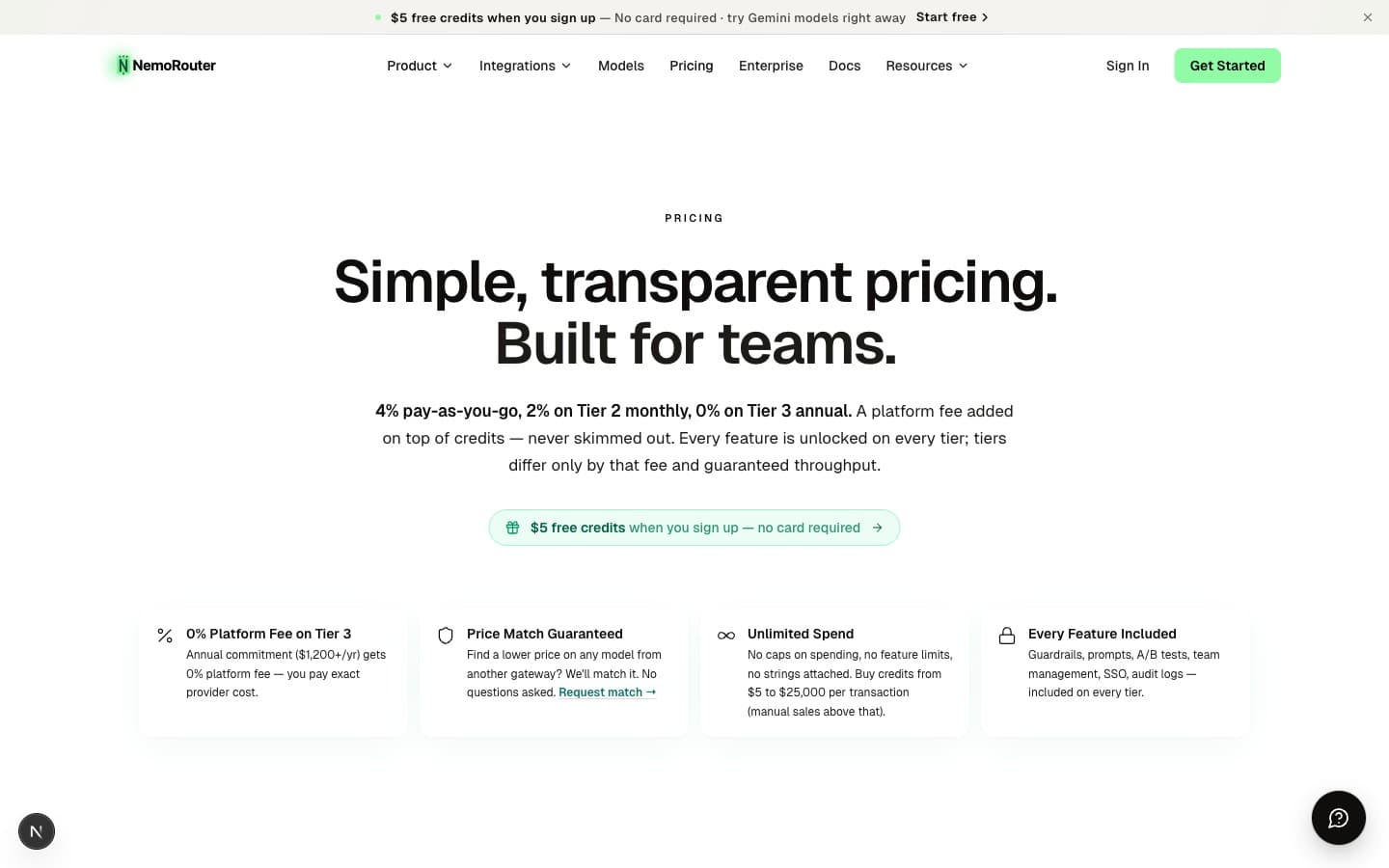
Nemo Router uses a credit-based system with a platform fee that decreases as you scale:
| Tier | Monthly Minimum | Platform Fee | Features |
|---|---|---|---|
| Tier 1 (Pay As You Go) | $0 | 4% | All features included |
| Tier 2 | $100/mo | 2% | All features included |
| Tier 3 | $1,200/yr | 0% | All features included |
| Enterprise | Contact sales | 0% | Custom SLAs + support |
All features are available on every tier. Higher tiers simply reduce the platform fee charged on top of your credit purchases.
Next Steps
- Quick Start — Make your first API call in under 2 minutes
- Authentication — Learn how API keys and auth work
- Chat Completions — Explore the Chat Completions API
- Python SDK — Get started with the Python SDK