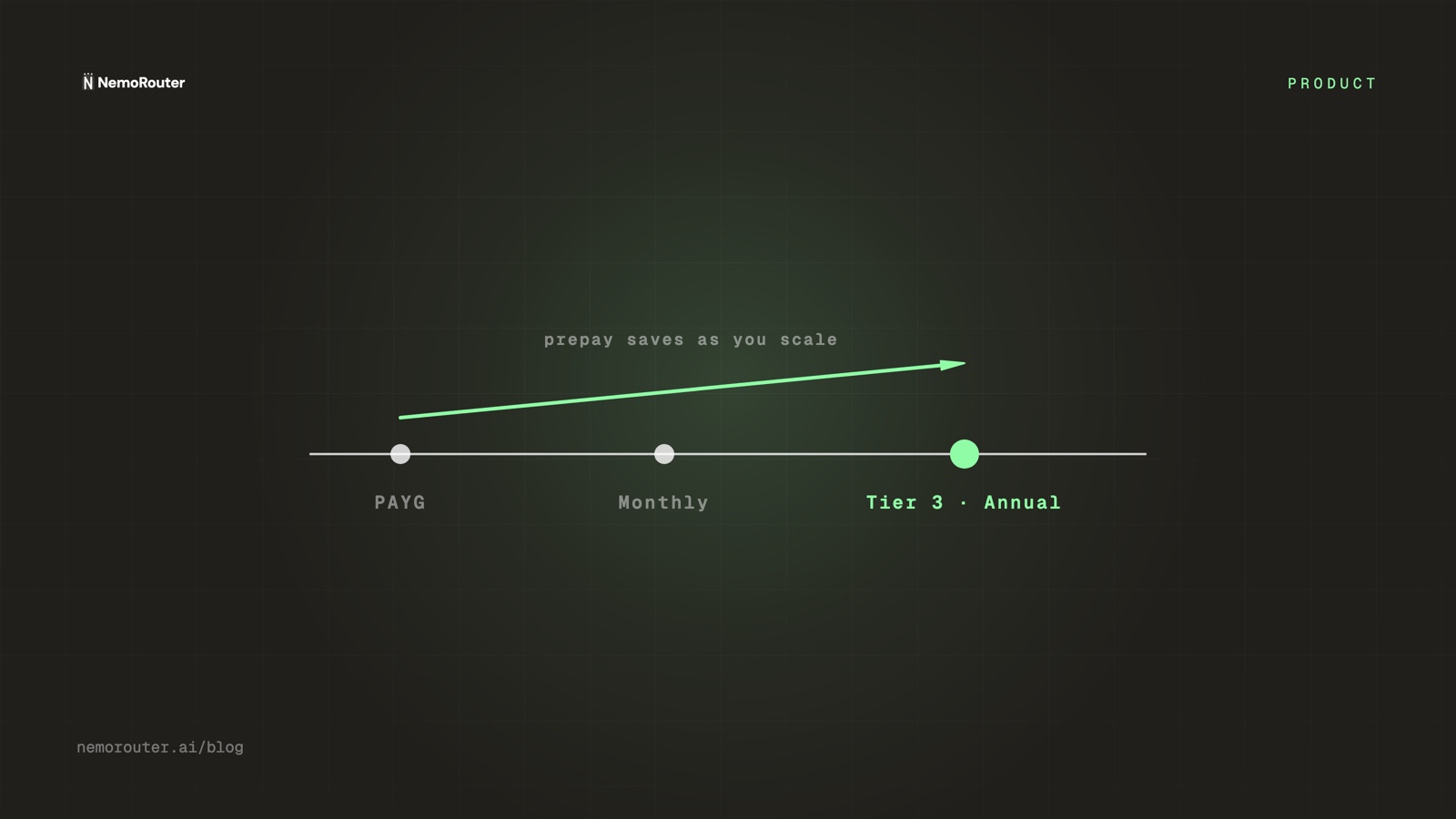
The wedge claim: nRouter is the only LLM gateway that gives every customer all enterprise features — guardrails, A/B tests, prompt management, evals, budgets — free for life, with every major LLM provider behind one API key. Plans vary the platform fee (4% pay-as-you-go, 0% on Pro); they never lock features.
Every LLM-gateway pricing page has the same shape: a "free" or PAYG plan with a percentage skim, one or two paid plans with a monthly minimum, and a "contact sales" door for the annual conversation. The advice that gets repeated in staff-engineering Slack is "stay on PAYG until you're sure, then commit." The advice is usually wrong — or, more precisely, it stops being right at a lower number than most teams realize.
This post draws the line. On nRouter, Pay as you go is billed at a flat 4% platform fee with no minimum, and Pro is $50/month (or $500/year) at a 0% platform fee with 1,000 RPM / 1M TPM throughput. We will show, with sourced math, the exact monthly spend at which Pro becomes the cheaper option, why the same volume that makes Pro sustainable also funds the provider reservations that compound the next savings round, and the three operational guards that decide whether you should still wait. Teams spending $1k–$50k/mo of LLM spend are the audience.
Five-minute path: the two plans in one table, the breakevens, the worked example.
The two plans in one table
Source of truth is the mono-repo pricing surface. No invented numbers, no promo "0% for life" framing — the anchor copy is "flat 4% pay-as-you-go, 0% on Pro".
| Plan | Price | Platform fee on provider spend | RPM | TPM | What you commit to |
|---|---|---|---|---|---|
| Pay as you go | $0, no minimum | 4% | 200 | 200K | Nothing. Pay only for what you use. |
| Pro | $50/mo or $500/yr | 0% | 1,000 | 1M | A monthly or annual subscription. Cancel anytime. |
| Enterprise | Custom | 0% | Custom | Custom | Custom contract. |
The feature set is identical across all three. Neither plan unlocks guardrails, A/B routing, prompt management, evals, per-team budgets, multi-tenancy, or virtual keys — those ship on Pay as you go the moment you sign up. The only things that vary are (a) the percentage we take on top of provider cost and (b) the throughput ceilings.
That is the entire pricing surface. Compare to the other gateways teams shortlist in 2026 — OpenRouter, Portkey, and Helicone all gate at least three governance features behind paid tiers or sales calls. The buyer's guide walks the same exercise across the full shortlist.
The two breakevens
There are two numbers worth memorizing. Each is the monthly LLM spend at which upgrading to Pro pays for itself on a pure platform-fee basis. The math is grade-school arithmetic — annualize, multiply, subtract — and we encourage you to redo it on your own invoice.
Breakeven A — Pay as you go → Pro annual at ~$1,042/month
Pro annual costs $500/year flat at 0%; Pay as you go charges 4% with no fixed cost. The annual plan is cheaper when the 4% you save on Pay as you go exceeds Pro's $500/year price:
0.04 × annual_spend = 500
annual_spend        = 12,500   →  ~$1,042/month
Above ~$1,042/month of provider spend, the Pro annual plan beats Pay as you go on platform fees alone. Below it, Pay as you go is correct.
Breakeven B — Pay as you go → Pro monthly at $1,250/month
Pro monthly costs $50/month at 0%. It beats Pay as you go's 4% the moment the fee you would otherwise pay each month exceeds $50:
0.04 × monthly_spend = 50
monthly_spend        = 1,250
Above $1,250/month, Pro wins on either billing interval. Between ~$1,042 and $1,250/month the annual plan is the one that pays for itself; the monthly plan catches up at $1,250. Pro annual ($500/yr) is $100/year cheaper than paying $50/month for twelve months — two months free — so any steady user who has cleared Breakeven A picks the annual option.
The breakeven table, then:
| Today's monthly LLM spend | Cheapest plan on platform fee | Why |
|---|---|---|
| Under ~$1,042/mo | Pay as you go | 4% of your annual spend is less than Pro's $500/yr; pay only for what you use. |
| ~$1,042/mo – $1,250/mo | Pro annual ($500/yr) | 4% saved already exceeds Pro's $500 annual price; the monthly plan's $50/mo isn't cleared yet. |
| Over $1,250/mo | Pro (monthly or annual) | 4% saved exceeds even the $50/mo price; Pro wins on either interval and the platform fee is 0%. |
| Sustained > 1,000 RPM / 1M TPM | Enterprise | Throughput beyond Pro's ceilings becomes the Enterprise conversation. |
The math is the same one the cost teardown draws as Lever 2 of the four-lever 60% recipe; this post zooms in to the plan decision itself.
Worked example — the month the CFO asks
A real-shaped scenario, anonymized as acct_b3c1. Mid-market SaaS, ~80
employees, ChatGPT-shaped product feature, twelve months on Pay as you go.
Twelve-month rollup, Pay as you go:
- Provider spend (OpenAI + Anthropic direct, routed through nRouter): $84,000
- Platform fee at 4%: $3,360
- Gateway total: $3,360
- Pay as you go floor: $0
- Total annual gateway cost: $3,360
Pro counterfactual, same year:
- Provider spend: $84,000 (unchanged — provider PAYG retail does not change)
- Platform fee at 0%: $0
- Pro annual subscription: $500
- Total annual gateway cost: $500
Delta: $2,860/year (85% reduction on gateway cost). Plus 5× the throughput ceiling (1,000 RPM / 1M TPM vs. 200/200K), which a launch-week incident makes useful approximately once a year.
Three things this example does not claim:
- It does not save 85% on the LLM bill. The provider bill is $84k either way; you are saving on the gateway layer. The 60% headline in the cost teardown requires stacking the plan change with the other three levers (gateway switch, provider reservations, prompt slop deletion).
- It does not assume any reservation discount. Reservations engage post-$10k ARR on the gateway side — see the next section. The Pro customer sees provider PAYG retail today; the spread becomes our margin when we cross the trigger.
- It is not a promo. "0% on Pro" is the published price, on the published pricing page, with no end date. The pricing page is the contract.
If your own invoice clears the ~$1,042/mo annual breakeven, copy the table above into a slide and run it past your CFO. If it does not, stay on Pay as you go — that is the audit working as intended.
Why Pro can carry a 0% platform fee
Most "annual contract" pages are a flat discount: pay early, save 10–20%, the vendor's margin is the same either way. nRouter's Pro plan is structurally different, and the structure is the wedge.
The mechanic: after $10k ARR, aggregated customer volume becomes large enough to buy provider-side reservations — Azure OpenAI PTU, Google GSU / Committed Use Discounts, AWS Bedrock Provisioned Throughput. Yearly reservations save up to 70%, monthly up to 30%. Customers continue paying full PAYG retail through the gateway; the spread becomes our gross margin.
Pro is the funding structure for that mechanic. Aggregated subscription and credit volume lets us commit to provider reservations whose annual savings shape matches steady customer demand. The customer's price does not change — they continue paying provider PAYG retail through the gateway — and the reservation spread becomes our margin instead of being clawed back through a higher platform fee.
The published reservation economics, sourced from each provider's own pricing surface (linked in Sources):
| Provider | Reservation product | Annual discount vs. PAYG | Monthly discount |
|---|---|---|---|
| Microsoft Azure OpenAI | Provisioned Throughput Units (PTU) | up to 70% | up to 30% |
| Google Cloud Vertex AI | Provisioned Throughput + 1y/3y Committed Use Discounts (CUDs) | ~37% (1y) / ~55% (3y) | n/a |
| AWS Bedrock | Provisioned Throughput (model units) | ~30–50% | hourly + monthly options |
Those numbers belong to the provider, not to nRouter. We do not promise the customer a 70% discount; we promise a 0% platform fee on Pro today, and we use the provider spread to fund the business that delivers it.
When to stay on Pay as you go — three operational guards
We would rather you stay on Pay as you go than subscribe against the wrong shape. Three cases where Pro is the wrong choice even above $1,250/mo:
- Your spend is spiky on a fortnightly horizon. If three of the last six months were below $500/mo and three were above $2,500/mo, the average clears the breakeven but the trough does not. Stay on Pay as you go until the trough also clears, or start on Pro monthly (cancelable) rather than committing to the annual plan.
- You are evaluating a model migration that will halve your spend. If a Claude → cheaper-model swap or a Haiku 4.5 substitution is queued for next quarter, the post-migration breakeven may slip below $1,250/mo. Start on Pro monthly rather than the annual commitment, or run the buyer's guide § 90-minute evaluation first, decide the model shape, then revisit the plan.
- You have under 60 days of cash runway. The Pro annual subscription is a one-time outflow. If twelve months of runway is not certain, choose Pro monthly or stay on Pay as you go — the $0 floor keeps your gateway bill correlated with your usage.
If none of those three guards trip, the math is clear. The signup form is /signup; the upgrade path is /pricing.
Switching cost: zero engineering work
This is the part most teams misprice. Moving from Pay as you go to Pro is a
billing change, not an integration change. Same base_url, same API keys,
same SDK, same routing config. The two-line OpenAI / Anthropic SDK diff covered
in the buyer's guide
is migration into nRouter from a competitor gateway — and even that is
half a day. Moving between nRouter plans is one click on
/pricing. No deploy, no SDK upgrade, no key rotation, no downtime.
That is the part of the math that does not show up in the breakeven table. If the engineering cost of a Pay as you go → Pro transition were a person-week, the breakeven would shift right by several thousand dollars. It is zero, so it does not.
The 90-second decision
Three numbers from your own invoice:
- Last 12 months of provider spend through your current gateway (or sum of OpenAI + Anthropic + Vertex invoices if you are still direct). Annualize if you have less than 12 months.
- Divide by 12 — that is your monthly average.
- Compare against the breakeven table above.
If you are below ~$1,042/mo: Pay as you go is correct, no decision to make.
If you are between ~$1,042 and $1,250/mo: Pro annual saves you money and gives 5× throughput. If your CFO has even a soft preference for an annual line item, you are done.
If you are above $1,250/mo: Pro is strictly dominant on price and throughput, on either billing interval. There is no plan B except Enterprise — and Enterprise is the conversation when throughput exceeds 1,000 RPM / 1M TPM sustained, not before.
If you would rather we run the exercise against your invoices, that is what the 30-minute walk-through on /community is for — bring the last 90 days. We will not pitch you Pro if the math says Pay as you go; the audit cuts both ways.
Try it on your own numbers
Load your first $5 in credits and we add a $10 bonus, so you start with $15 in API credits. Enough to exercise routing, guardrails, A/B tests, and per-team budgets on real traffic, and to validate the math before any subscription. Pro is a single click from the same dashboard.
→ Get started at nemorouter.ai/signup — Pay as you go from $5, with $10 bonus credits on your first purchase. No subscription. Already running over $1,250/mo? Skip to /pricing and pick Pro directly. Mid-market SaaS or larger? Bring 90 days of invoices to a 30-min walk-through (book through /community).
See also
- OpenRouter alternative — every enterprise LLM-gateway feature, free for life
- How we cut LLM costs 60% without locking features behind an enterprise tier
- LLM gateway buyer's guide 2026
- /pricing — canonical Pay as you go / Pro / Enterprise table
Sources
Provider reservation pricing pages, verified 2026-05-16:
- Azure OpenAI Service pricing (PTU): azure.microsoft.com/en-us/pricing/details/azure-openai/
- Google Vertex AI generative AI pricing (Provisioned Throughput + CUDs): cloud.google.com/gemini-enterprise-agent-platform/generative-ai/pricing
- AWS Bedrock pricing (Provisioned Throughput): aws.amazon.com/bedrock/pricing/