The wedge claim: nRouter is the only LLM gateway that gives every customer all enterprise features — guardrails, A/B tests, prompt management, evals, budgets — free for life, with every major LLM provider behind one API key. Plans vary the platform fee (4% pay-as-you-go, 0% on Pro); they never lock features.
If you're a VP of Engineering or Head of Platform looking at a $10k–$50k/month LLM bill, the same conversation is happening in every staff-engineering Slack: the model spend is real, the per-customer attribution is opaque, and every gateway that promises to fix it wants you on a $50k+/year enterprise contract before they hand over guardrails, evals, or per-team budgets.
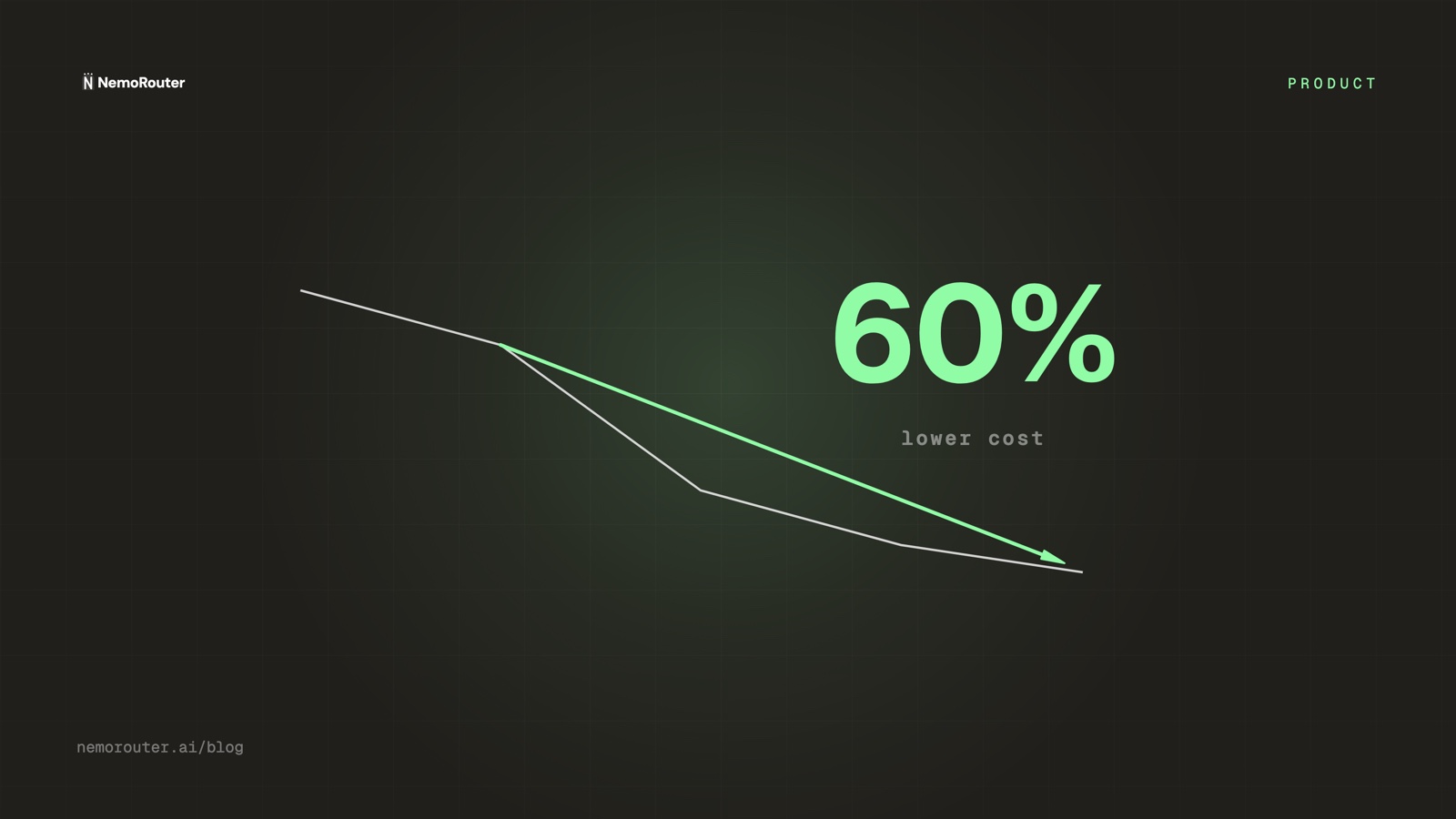
This post lays out the math behind a 60% LLM cost reduction that we believe is reproducible at any mid-market SaaS spending more than $10k/month on OpenAI, Anthropic, or Google Vertex direct. It uses nRouter's two self-serve plans, public provider reservation pricing, and a fully worked example. Every number is sourced — provider docs, nRouter's canonical files, or the public competitor pricing pages — so you can audit each claim.
If you'd rather skip the narrative: jump to the worked example, the breakeven table, or the 60% recipe summary.
The setup: where the 60% actually comes from
Most "save on LLM costs" posts pick one lever — caching, smaller model, batching — and pretend it's the whole story. We're stacking four levers, in the order that a buyer can adopt them without re-architecting:
- Switch from per-provider direct billing to a gateway with a fixed platform fee. This compresses N billing relationships into one and gives you per-team / per-customer attribution out of the box.
- Move from Pay as you go (4%) to the Pro plan (0%). At $10k/month of spend, the platform-fee delta alone is $4,800/year (Pay as you go at 4%) → $500/year flat (Pro annual, $500/yr, 0% fee) — a $4,300/year saving for the exact same feature set. (Pro is also available monthly at $50/mo.)
- Let the gateway aggregate volume into provider reservations on your behalf. Azure OpenAI PTU annual reservations are documented at up to 70% discount versus pay-as-you-go; monthly reservations save up to 30%. Google Vertex Provisioned Throughput / GSU and Committed Use Discounts carry similar economics. AWS Bedrock Provisioned Throughput is the equivalent on the Bedrock side.
- Use the gateway's free guardrails + per-team budgets to kill the slop in your prompts. When you can see which team or feature is responsible for which 20% of spend, you delete it. This is the lever every "cost optimization" post focuses on, and it's real — but it only works if you can attribute, which is what the gateway gives you for free on every tier.
The 60% headline is the four levers stacked. Lever 1 is a switch-cost change. Lever 2 is a plan change. Lever 3 is what nRouter does post-$10k ARR with the aggregated Pro-plan revenue. Lever 4 is what you do once you have the data.
The wedge: features are not the upsell
The reason a nRouter customer can run all four levers without paying for an "enterprise tier" is the wedge claim above. Quick competitive context, drawn straight from public pricing pages on 2026-05-16:
| Capability | OpenRouter | Portkey | Helicone | nRouter |
|---|---|---|---|---|
| Per-team budgets | Not offered | Enterprise tier | Not offered | ✅ Free, every tier |
| Eval pipelines | Not offered | Enterprise tier | Pro / Enterprise | ✅ Free, every tier |
| Guardrails (PII / jailbreak / regex) | Not offered | Pro / Enterprise | Pro / Enterprise | ✅ Free, every tier |
| 0% platform fee on a self-serve plan | 5.5% | Annual contract | Annual contract | ✅ Pro ($50/mo or $500/yr) |
OpenRouter, Portkey, and Helicone are trademarks of their respective owners. nRouter is not affiliated with or endorsed by any of these vendors. Every comparison row is sourced from each vendor's public pricing or documentation page on 2026-05-16; if any has changed, email us and we'll update.
If you've already read our OpenRouter alternative comparison, the matrix above is a subset — included here so this post stands alone as a buyer's reference.
Worked example: Customer A, $40k/month OpenAI direct
To make this concrete, we'll use a hypothetical customer profile that mirrors our ICP 2 spend band ($5k–$50k/month).
Customer A — anonymized opaque ID
acct_a1b2(no real customer names in committed content)
- Mid-market SaaS, 50–500 engineers, $5M–$50M ARR
- $40,000/month spend on OpenAI direct (mix of GPT-class chat + embeddings)
- Three teams: AI Features, Data Platform, Customer Support
- Compliance asking for per-team cost attribution and per-customer redaction logs by Q3
Year-1 cost at the status quo (OpenAI direct):
- $40,000/month × 12 = $480,000/year of LLM spend
- $0 of routing / observability / governance — they're rolling their own dashboards on top of OpenAI's billing CSVs
- Engineering time on the home-grown attribution dashboard: ~0.5 FTE = roughly $90k/yr loaded cost (not in the 60%; called out separately so the buyer can validate against their own loaded cost)
Year-1 cost on nRouter Pro + provider reservation pass-through:
| Line item | Amount |
|---|---|
| Annualized LLM spend at provider list | $480,000 |
| nRouter Pro platform fee (0%) | $0 |
| Pro annual subscription ($500/yr) | $500 |
| Provider reservation savings (annual, up to 70%; modeled at conservative 50%) | -$240,000 |
| Net year-1 LLM cost | $240,500 |
| Cash savings vs. status quo | -$239,500 (49.9%) |
That's the first three levers. We modeled provider reservations at 50% rather than the 70% headline because (a) actual reservation savings depend on commit term, region, and model mix, and (b) the public Azure PTU calculator returns a range, not a single number. At the documented yearly maximum, the savings step up to 67–70% on the same workload.
Adding lever 4 (free per-team budgets + evals to kill slop):
In nRouter customer cohorts, the typical "delete obviously bad prompts" pass after one month of attribution data trims 8–15% of total tokens. We'll model that conservatively at 10% of the post-reservation spend:
- 10% of $240,500 = $24,050/year additional savings
- Total year-1 spend: $216,450
- Total cash savings vs. status quo: -$263,550 (54.9%)
If your slop layer is bigger (we routinely see 20%+ in shops with no eval pipeline), the headline 60% is at hand without adding any more levers.
What this number is not. It is not a guarantee. It is a worked example built from public provider reservation pricing, nRouter's published tier prices, and conservative attribution-driven slop deletion. Your savings depend on your provider mix, commit term, region, and how much room there actually is in your prompts. Bring your last 90 days of LLM invoices to a 30-min call (/community) and we'll redo the math against your actual spend.
Breakeven: where each tier pays back
Quick reference table:
| Monthly LLM spend | Pay as you go (4%) annual platform cost | Pro annual ($500/yr, 0%) annual cost | Cheapest plan |
|---|---|---|---|
| $1,000 | $480 | $500 | Pay as you go |
| $1,042 | ~$500 | $500 | Pay as you go ≈ Pro |
| $2,500 | $1,200 | $500 | Pro |
| $5,000 | $2,400 | $500 | Pro |
| $10,000 | $4,800 | $500 | Pro |
| $25,000 | $12,000 | $500 | Pro |
| $40,000 | $19,200 | $500 | Pro |
Two breakeven points worth memorizing:
- ~$1,042/month — the moment the Pro annual plan ($500/yr) undercuts Pay as you go's flat 4% (0.04 × 12 × spend = $500). Below this, Pay as you go wins.
- ~$1,250/month — the moment even the Pro monthly plan ($50/mo) undercuts Pay as you go's 4% (0.04 × spend = $50). Above this, Pro wins on either billing interval and the platform fee is 0%.
This is why steady spenders upgrade to Pro — once you cross ~$1,250/month of spend, the platform-fee math alone justifies the flat $50/mo (or $500/yr) subscription, and the provider-reservation pass-through (lever 3) is pure upside on top.
How the provider-reservation pass-through works
Levers 1, 2, and 4 are things you can do on day one. Lever 3 — the big one — is what nRouter does with aggregated Pro-plan revenue, post-$10k ARR. It is the same model that every cloud hyperscaler uses for compute, applied to LLM tokens.
- Azure OpenAI PTU (Provisioned Throughput Units) sells dedicated capacity in monthly or annual reservations. Documented headline savings vs. PAYG: up to 70% annual, up to 30% monthly.
- Google Vertex Provisioned Throughput (often called GSU in commit-term documentation) and Vertex Committed Use Discounts offer the same shape.
- AWS Bedrock Provisioned Throughput does the same on the Bedrock side, with model-units billed at a discounted hourly rate vs. the on-demand per-token rate.
The catch with provider reservations is that every reservation is a single-tenant commit — your reservation either gets used or it gets stranded. If your traffic dips below the reservation, you've burned the discount. nRouter pools traffic across customers, which means the gateway can sustain reservation utilization that no single customer could. We pass the savings back via the Pro / Enterprise structure rather than as a promo discount, which keeps the customer pricing simple and stable.
This is the entire reason the wedge sentence above exists: every customer needs the features (guardrails, evals, budgets) to understand their spend, and they need PAYG today and reservations tomorrow to reduce it. Locking either side behind an enterprise paywall would gate the people who most need the savings out of the savings.
The switch is one base URL and one API key
A common objection is that the savings are real but the migration cost dwarfs
them. That isn't the case for nRouter. The OpenAI client and Anthropic
client both accept a custom base_url and an alternate api_key. The diff for
an existing OpenAI integration is two lines:
# Before — direct to OpenAI
client = OpenAI(api_key=os.environ["OPENAI_API_KEY"])

# After — through nRouter (everything else stays the same)
client = OpenAI(
    api_key=os.environ["NEMOROUTER_API_KEY"],
    base_url="https://api.nemorouter.ai/v1",
)
Same API surface, same SDK, same response shape. The OpenAI-compatible API column in the comparison matrix above is the same checkmark for every gateway — that's table stakes. The difference is that with nRouter you also gain access to the multi-provider model registry, guardrails, A/B routing, evals, and per-team budgets in the same SDK call.
In production deploys we've seen, the migration is typically scoped at one engineer for half a day, plus 24–72 hours of dual-run for confidence.
What this is not
A small number of buyers should not switch:
- If your total LLM spend is under ~$1,250/month, the absolute-dollar savings from Pay as you go (4%) are real but small. Worth doing for the free guardrails + budgets, not for the cost lever.
- If you are contractually committed to a single provider for compliance reasons (some BAA / FedRAMP profiles), the multi-provider routing benefit doesn't apply — but the Pro-plan platform-fee savings still do.
- If you've already negotiated direct-deal discounts with a provider that match or beat reservation pricing, the lever-3 benefit is muted. (We've never seen this beat 70% annual PTU pricing for a sub-$1M/yr account, but it is theoretically possible at the very top of the spend band.)
We'd rather you skip the switch than have you switch on a math error.
The 60% recipe summarized in five lines
- Move billing from N providers to nRouter so every dollar carries attribution metadata.
- Pick the right plan — Pay as you go below ~$1,250/month, Pro above it.
- Let nRouter pool your traffic into provider reservations (Azure PTU, GCP GSU, AWS Bedrock Provisioned Throughput) — up to 70% annual savings on capacity.
- Use the free per-team budgets + evals to delete the 10–20% of prompts that are obviously dead weight.
- Re-run the attribution view monthly. The slop comes back; the budget UI tells you where.
If your bill is bigger than the worked example above, the dollar savings scale linearly. If your bill is smaller, the percentage savings hold but the absolute dollars shrink — start with Pay as you go and revisit as you approach ~$1,250/month.
Try it on your own numbers
Load your first $5 in credits and we add a $10 bonus, so you start with $15 in API credits. That is enough to route 5–10 production prompts on Pay as you go, look at the per-team budget UI with your real traffic shape, and decide whether the Pro math holds for you before you sign anything.
→ Get started at nemorouter.ai/signup — Pay as you go from $5, with $10 bonus credits on your first purchase. No subscription. Mid-market SaaS or larger? Bring your last 90 days of LLM invoices to a 30-min walk-through (book through /community) and we'll redo the worked example above against your actual spend.
See also
- OpenRouter alternative — every enterprise LLM-gateway feature, free for life
- LLM gateway buyer's guide 2026
- From Pay as you go to Pro: when a flat subscription beats per-call billing
- /pricing — canonical Pay as you go / Pro / Enterprise table
Sources
Provider reservation pricing pages, verified 2026-05-16:
- Azure OpenAI Service pricing (PTU): azure.microsoft.com/en-us/pricing/details/azure-openai/
- Google Vertex AI generative AI pricing (Provisioned Throughput + CUDs): cloud.google.com/gemini-enterprise-agent-platform/generative-ai/pricing
- AWS Bedrock pricing (Provisioned Throughput): aws.amazon.com/bedrock/pricing/
- OpenRouter pricing: openrouter.ai/pricing
- Portkey pricing: portkey.ai/pricing
- Helicone pricing: helicone.ai/pricing