The wedge claim: NemoRouter is the only LLM gateway that gives every customer all enterprise features — guardrails, A/B tests, prompt management, evals, budgets — free for life, with every major LLM provider behind one API key. Tiers vary the platform fee (4% / 2% / 0%); they never lock features.
If you typed "Claude proxy" into Google, you almost certainly want one of five things. We see the same pattern from every team that scales Anthropic usage past a handful of engineers:
- Rate-limit overflow. Anthropic's per-org RPM/TPM limits start biting around the time you ship Claude into a real product. You need a layer that can absorb spikes, fail over to a sibling model, or shard load across keys.
- Per-team cost attribution. Anthropic bills the org. You need to know which team, customer, or feature is responsible for the bill — without wiring a parser into every service that calls Claude.
- Guardrails + observability. PII scrubbing, jailbreak detection, logging to your own data lake — these are not Anthropic's product; they belong in front of every Claude call.
- OpenAI-compatible API. You started on OpenAI, now you want Claude, and you don't want two SDKs in the same service. You want one base URL, one key format, one error shape.
- Multi-provider routing without re-auth. Today it's Claude; in six weeks
it might be Gemini 2.5 Pro or
gpt-4.1-minifor the cheap path. Re-doing auth + key vault wiring per provider doesn't scale.
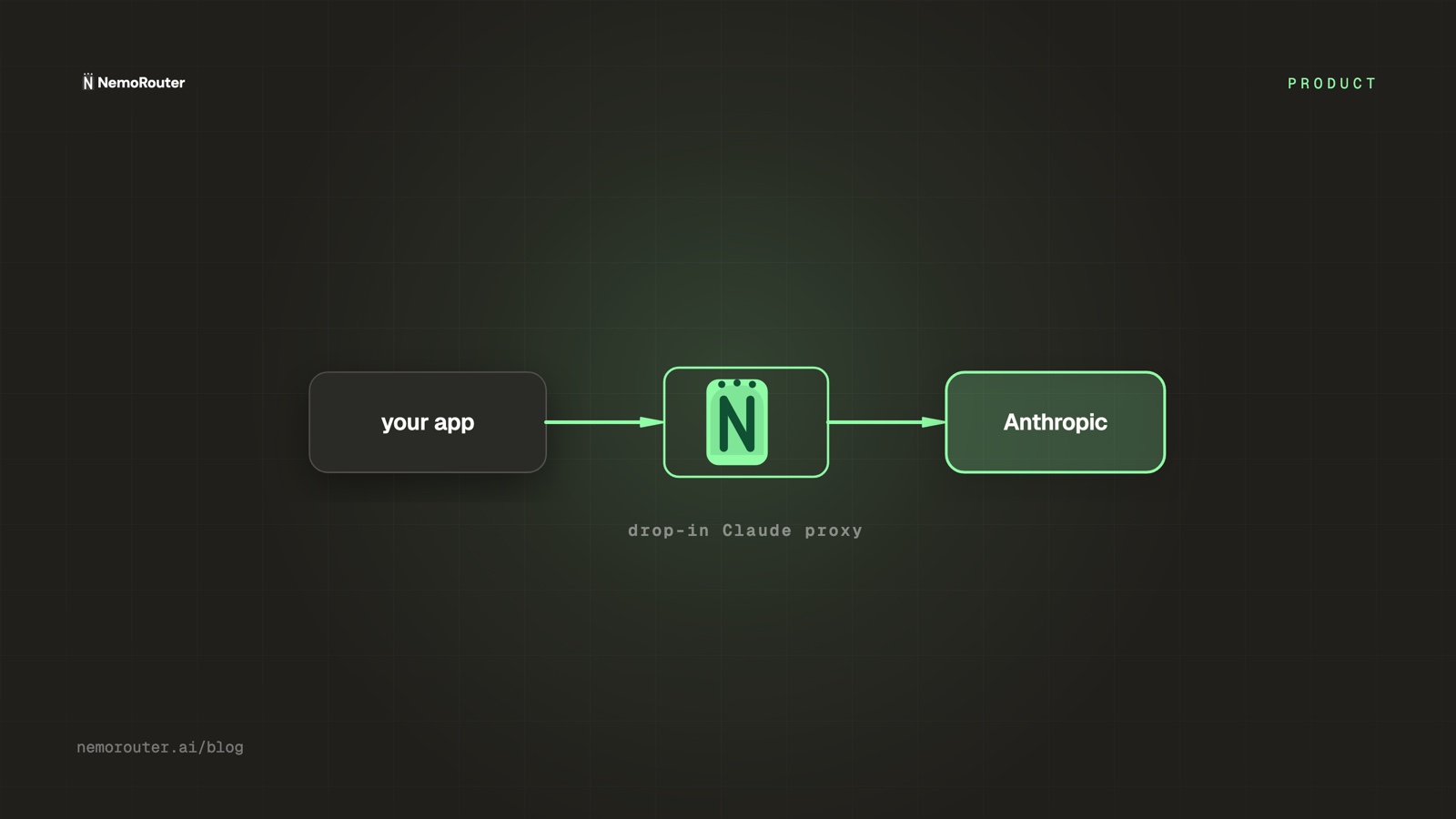
NemoRouter is built for these five problems. It is a drop-in Anthropic proxy that you point your existing code at with one base-URL change — no SDK swap, no schema migration, no per-provider key vault. This post walks through what a Claude proxy actually has to do, and what's in the box on day one with NemoRouter.
Request flow
What happens inside Nemo Router when your app calls a model.
Onboarding
From sign-up to your first API call in five steps.
Architecture
The services in the request path and where data lives.
What happens inside Nemo Router when your app calls a model.
What a Claude proxy actually has to do
Most teams that "just need a proxy for Claude" end up writing the same six features in roughly the same order. The order is dictated by which production incident hits first:
| # | Capability | Triggering incident | NemoRouter status |
|---|---|---|---|
| 1 | Retry + fallback on 529 overloaded_error | First weekend of real traffic | ✅ Included free, every tier |
| 2 | Per-team / per-API-key spend attribution | First end-of-month bill audit | ✅ Included free, every tier |
| 3 | PII / jailbreak / regex guardrails in front of Claude | First security review | ✅ Included free, every tier |
| 4 | Per-team budgets + alerts | First runaway-script incident | ✅ Included free, every tier |
| 5 | Logging Claude requests + responses to S3 / Langfuse / Datadog | First "what did the model see?" debug | ✅ Included free, every tier |
| 6 | A/B testing Claude vs. a sibling model on the same prompt | First "is claude-3-5-haiku enough?" question | ✅ Included free, every tier |
Each of those is a multi-week build if you write it yourself. The reason teams keep building them anyway is that no single Anthropic-adjacent product ships all six in one place at a price that survives the next bill audit.
Claude, Anthropic, OpenAI, OpenRouter, Portkey, and Helicone are trademarks of their respective owners. NemoRouter is not affiliated with or endorsed by Anthropic. All Anthropic-specific claims below are sourced from Anthropic's public documentation on the dates linked at the bottom; if any of these have changed, email us and we'll update.
The migration: one base URL, one key, ten minutes
NemoRouter exposes an OpenAI-compatible API that maps to every major provider, Anthropic included. Whether your existing code uses the Anthropic SDK or an OpenAI-compatible client, the switch is a base-URL change:
From the OpenAI SDK pointed at Anthropic via an existing proxy:
  // OpenAI-compatible client, was hitting Anthropic via another gateway
  const client = new OpenAI({
-   baseURL: 'https://api.anthropic.com/v1/',
-   apiKey: process.env.ANTHROPIC_API_KEY,
+   baseURL: 'https://api.nemorouter.ai/v1',
+   apiKey: process.env.NEMOROUTER_API_KEY,
  });

  const reply = await client.chat.completions.create({
    model: 'claude-3-5-sonnet-latest', // model id stays as the upstream provider uses
    messages: [{ role: 'user', content: 'Summarize this in one sentence.' }],
  });
Two environment variables. One base URL. No SDK rewrite. The model id is the same string Anthropic publishes — NemoRouter resolves it across providers without you re-encoding model names. Most teams have real Claude traffic flowing through NemoRouter in under ten minutes; the explicit cold-start target is signup → first API call in under 60 seconds.
If your code uses Anthropic's native messages.create() shape, the same swap
applies — NemoRouter accepts both the OpenAI Chat Completions shape and the
Anthropic Messages shape on the same endpoint. You don't have to standardize
your codebase before switching.
Why "Claude proxy" is usually a code-smell for a missing control plane
The reason teams keep typing "Claude proxy" into Google is that the proxy
layer is the symptom of a deeper need: a control plane in front of every
LLM call, not just Claude. Once a team has guardrails, budgets, A/B tests,
and observability sitting in front of Claude, they want the same set of
controls in front of every other model they call — gpt-4.1, gemini-2.0-flash,
grok-2, an on-prem fine-tune, anything.
NemoRouter is that control plane. Anthropic is one provider behind it. The features that make it useful for Claude — guardrails, retries, fallbacks, budgets, observability, A/B tests — also work for every other model in the catalog (over two thousand models across the major providers, behind one NemoRouter API key).
That's the wedge: you stop writing a proxy and start using a gateway. The gateway has the proxy semantics you wanted (one base URL, drop-in shape) plus the control plane you would have eventually built anyway.
Pricing tiers explained
| Tier | Price | Platform fee on top of provider cost | Best for |
|---|---|---|---|
| Tier 1 — PAYG | $0 | 4% | Trying NemoRouter; under $2.5k/mo of Claude / total LLM spend |
| Tier 2 | $100/mo min | 2% | $2.5k–$10k/mo spend, ready to commit monthly |
| Tier 3 | $1,200/yr min | 0% | $10k+/mo spend, annual budget approved |
| Enterprise | Custom | 0% | F1000, BAA, SOC 2-prep, multi-region |
The same things worth saying out loud on every other NemoRouter pricing page apply here:
- All features are unlocked on every tier. Tier 1 customers calling Claude have the same guardrails, retries, A/B tests, per-team budgets, and observability as Enterprise. There is no feature flag we flip when you upgrade — upgrading only changes the platform fee and the rate limits.
- Tier 1 is real. No card is required to start, and we auto-grant $5 in API credits on signup — enough to run Claude across a few models and decide whether the migration is worth your weekend.
- Tier 3 is the acquisition target, by design. Annual prepay funds the next round of provisioned-capacity reservations on the provider side — Anthropic enterprise capacity, Azure OpenAI PTU, Google GSU, AWS Bedrock Provisioned Throughput. The 0% platform fee on Tier 3 is not a loss leader; it is the price of moving you onto the tier that funds the spread.
If you want to model your own breakeven: at a 4% Tier 1 fee, every $2,500/mo of Claude spend = $100/mo platform fee, which is exactly the Tier 2 minimum. Past $2.5k/mo, Tier 2's 2% saves you money the moment you cross. Tier 3 pays back vs. Tier 2 around $10k/mo of annualized spend.
When NemoRouter is the right Claude proxy
You should switch to NemoRouter as your Claude proxy if two or more of the following are true:
- Your monthly Anthropic bill is large enough that a 1-percentage-point fee swing matters (roughly $1k+/mo).
- You're seeing
529 overloaded_errorfrom Anthropic in real traffic and need fallback to a sibling model (Sonnet → Haiku, or Claude →gpt-4.1) without bespoke retry code in every service. - You need guardrails, evals, A/B tests, or per-team budgets in front of Claude, and you're either building them yourself or paying a second vendor.
- You want to test Claude side-by-side with models from other providers (OpenAI, Google, Bedrock) without per-provider auth wiring.
- You have multi-team or multi-customer cost-attribution requirements for Claude spend (per-team budgets + per-team observability solve this out of the box).
- You'd prefer to lock in a 0% platform fee on Claude usage for the year via Tier 3 prepay rather than pay an opaque markup forever.
You should not switch if your only requirement is plain Anthropic API forwarding at under $200/mo with no need for retries / guardrails / budgets — at that scale, calling Anthropic directly is fine, and so is any of the single-purpose proxies on GitHub.
Try it
Tier 1 is free. No card, no commitment, $5 of API credits auto-granted on signup. You can be making real Claude calls through NemoRouter in under 60 seconds.
→ Start free at nemorouter.ai/signup
If you want the side-by-side with other gateways before switching, the head-to-head comparisons are at /vs/openrouter, /vs/portkey, and /vs/helicone — same data, with the JSON-LD markup that lets AI answer engines cite the comparison directly.
Questions? Drop into the public NemoRouter Slack — #support
for proxy / routing questions, #feature-requests if there's an Anthropic-side
capability you want next.
Sources
All Anthropic-specific claims above are sourced from Anthropic's public documentation. Verified 2026-05-18. If a referenced page has changed and we haven't refreshed, email hello@nemorouter.ai and we'll re-audit within one business day.
- Anthropic API rate limits + 529 overloaded errors: docs.anthropic.com/en/api/rate-limits
- Anthropic Messages API: docs.anthropic.com/en/api/messages
- Anthropic pricing: anthropic.com/pricing
- NemoRouter wedge claim + pricing tiers: /pricing
- NemoRouter head-to-head vs OpenRouter: /vs/openrouter